


A high converting VSL script follows one order: a hook in the first 5 to 30 seconds, a call-out and promise, a short story that earns trust, the problem, the big idea that solves it, proof, the offer and price, the guarantee, a clear call to action, and a close. Each part has one job: to get the viewer to keep watching until the next part. The format gets you a script that works. Testing the hook and the offer gets you one that makes money.
I’ve run paid traffic to info-product funnels for years. I scaled my publishing business to $1M a month and spent over $10M on ads before I sold it. Below is the format I’d hand anyone writing a video sales letter for a course, a coaching program or a book funnel, with example lines for one $97 course, the changes for a book-a-call VSL, and how to test the script once it’s live.
Key takeaways
The order matters more than the wording. Each part answers the question the viewer has at that moment, so moving the price before the proof breaks it.
The hook carries the whole video. If people leave in the first 30 seconds, nothing after it gets watched.
Low-ticket and book-a-call VSLs share the format but end differently: one sells on the page, the other sells a call.
Write 5 to 10 hooks, not one. Test them with a multi-armed bandit split and let the losers drop out early.
Judge on revenue per visitor. For a book-a-call VSL, use calls booked per visitor until the sales come in.
What a VSL script format is (and why it matters)
A VSL, or video sales letter, is a sales page turned into a video. The viewer lands on a page with a video and little else, and the video does the selling. The script is the written version of that video, line by line.
The format is the order of the parts. It matters because a viewer can’t skim a video. On a written sales page, someone can jump to the price. In a VSL they watch in the order you chose, so every part has to make the next one feel worth waiting for.
None of this structure is new. Direct-response copywriters used the same sequence in long-form sales letters for decades, and the classic problem, agitate, solve formula sits in the middle of it. If you’re still deciding between the two formats, I compare them in VSL vs long-form sales letter.
The 10-part VSL script format
Here’s the whole structure for a 15 to 20 minute VSL selling a $97 course. The times are rough. A shorter VSL squeezes the middle; the order stays the same.

The example offer through this section: a $97 course that teaches adults to play their favorite songs on piano from chord charts, without reading sheet music. All the script lines below are examples I wrote for this post, not lines from a real funnel.
1. The hook (0:00 to 0:30)
What it does: stops the viewer from leaving. It names a result they want or a problem they feel, in a way that makes them want the next sentence.
Why it matters: the first seconds are when most people decide to stay or go. Wistia’s video length data found that on 1 to 5 minute videos most viewers usually drop off around the halfway point, and engagement keeps falling after the five-minute mark. A VSL is usually longer than that, so it has to earn every minute, starting with the first.
Example line: “If you’ve ever sat at a piano and only been able to play the first three notes of a song, give me ten minutes. By the end you’ll know why, and how to fix it this week.”
2. The call-out and the promise (0:30 to 1:00)
What it does: tells the right people this is for them, and says what they’ll get by the end of the video.
Why it matters: the call-out filters. The people who stay are the ones who might buy. The promise gives them a reason to keep watching.
Example line: “This is for adults who always wanted to play but gave up on lessons. In this video I’ll show you the chord method that lets you play a full song in your first week.”
3. Story and credibility (1:00 to 3:00)
What it does: answers “why should I listen to you?” with a short, true story. Usually: you had the same problem, you found a different way, and it worked for you and then for others.
Why it matters: people buy from someone they believe. Keep it short and relevant. Nobody needs your life story, only the part that connects to their problem.
Example line: “I quit lessons twice. Both times it was the sheet music. Then a session player showed me he hadn’t read a note in 20 years.”
4. The problem and agitation (3:00 to 5:00)
What it does: describes the viewer’s problem better than they could, then shows what it’s costing them.
Why it matters: when you describe someone’s frustration in their own words, they trust that you understand the fix. Agitation makes the cost of doing nothing feel real. Don’t overdo it. The goal is recognition, not misery.
Example line: “You buy a keyboard, download an app, practice scales for three weeks, and still can’t play one song your friends would know. So it ends up under the bed.”
5. The big idea, or mechanism (5:00 to 8:00)
What it does: explains why the old way failed and what is different about your way. This is the reason your product works when other things didn’t.
Why it matters: your viewer has probably tried something before. If your offer sounds like more of the same, they assume it will fail the same way. A new mechanism gives them permission to try again without feeling foolish.
Example line: “Most songs use the same four chords. Learn those shapes and you can play hundreds of songs without reading a single note.”
6. Proof (8:00 to 10:00)
What it does: shows the big idea works for people like the viewer: student results, short testimonials, before and after clips, screenshots.
Why it matters: the mechanism makes a claim. Proof backs it up. Put it before the price so the viewer already believes the result when they hear the cost.
Example line: “Here’s Linda, 61. She’d never touched a piano. Day nine, she played ‘Let It Be’ for her grandkids.” (Only use real students and real results.)
7. The offer stack and price reveal (10:00 to 13:00)
What it does: lays out everything they get, what each part does for them, and then the price.
Why it matters: the price lands differently after the value is clear. Russell Brunson teaches this as “the stack” in his book Expert Secrets: you show each item, build up the total value, then reveal the price. Each item should solve a specific worry, not just add bulk.
Example line: “You get the 30-day chord course, the song library with 150 songs, and the practice tracker. Today it’s $97.”
8. The guarantee (13:00 to 14:00)
What it does: removes the risk of trying. A money-back guarantee, a results guarantee or a “keep the bonuses” promise.
Why it matters: on higher prices it usually lowers the fear of buying. But don’t assume it always helps. When I added a 30-day money-back guarantee to a $5 book funnel, it lost: the order-form opt-in fell from 69% to 44% and checkout from 47% to 31%, in two funnels, from January 30 to February 10. My guess is that on a $5 product it raised a doubt nobody had. Test the guarantee like any other part.
I Thought This Would Increase Sales… It Didn’t
Example line: “Try it for 30 days. If you can’t play a full song by then, email us and you get every cent back.”
9. The call to action (14:00 to 15:00)
What it does: tells them exactly what to do: click the button below the video, what happens next, and what they’ll see.
Why it matters: a viewer who is ready to buy can still hesitate at an unclear next step. Make the button and the words match.
Example line: “Click the yellow button under this video. You’ll go to a secure order page, and you’ll get your login in two minutes.”
10. The close and urgency (15:00 to the end)
What it does: recaps the promise, answers the last objections (“what if I’m too old?”, “do I need a real piano?”) and repeats the call to action. Urgency only if it’s real: a launch price that ends, a bonus that goes away.
Why it matters: some viewers decide in the last minutes. The close catches the ones still on the fence. Fake countdowns that reset on refresh cost you trust when people notice.
Example line: “You can keep watching tutorials, or you can play a song this week. Click the button below.”
What a script page looks like
When I write a VSL, the script is a document with the section names and rough times in the margin. That makes it easy to see if one part has grown too long, and easy to swap one section out for a test.

A few things I keep on the page:
The time each part starts. Why: if the price appears at minute 19 on a 20-minute video, too few people will ever hear it.
One idea per line. Why: short lines read naturally on camera and fit on a phone screen as captions. In my paid-ad funnels, 90% or more of the traffic is mobile.
Visual notes. “Show student clip”, “price slide”. Why: whoever edits the video knows what goes on screen.
Low-ticket VSL vs book-a-call VSL
The same 10 parts work for both. What changes is what the video asks for at the end, and how long each part runs.

Low-ticket VSL ($7 to $97, buy on the page):
Shorter, often 5 to 15 minutes. Why: a $27 or $97 decision doesn’t need 40 minutes of reasons.
Price reveal and button on the same page. The viewer clicks and goes straight to the order form.
The order page and upsells do part of the work. A video on the upsell page counts too. In one of my funnels, adding a video to upsell 3 lifted its conversion from 38% to 43% between September 25 and October 29, which was about $2,000 more.
Why Video Upsells Beat Text (Real Funnel Data)
Book-a-call VSL (high ticket, $2,000 and up):
Longer, and more filtering. Why: you want fewer, better calls. The call-out says clearly who it’s not for.
No price in the video, usually. The offer section explains what working together looks like, and the price comes on the call.
The call to action is the calendar. “Book a call below” replaces “buy now”, and the close explains what happens on the call so people turn up.
My friend Mike, who has run VSL funnels that have done millions in revenue, uses a mix: a $197 or $297 product sold by VSL, then one upsell, then a call. On a call I recorded with him, he said they’d settled on $297 for the past couple of years. They tried $497, and he said it got about the same EPC with less volume.
How to test your VSL script
A script is a guess until traffic says otherwise. Here’s how I test one, in order.
Step 1: Write 5 to 10 hooks
The hook is the cheapest part to change and the part every visitor sees. Don’t write one and polish it. Write 5 to 10 that come from different angles: the result, the pain, a surprising fact, an objection, a call-out to one audience, a story opening.
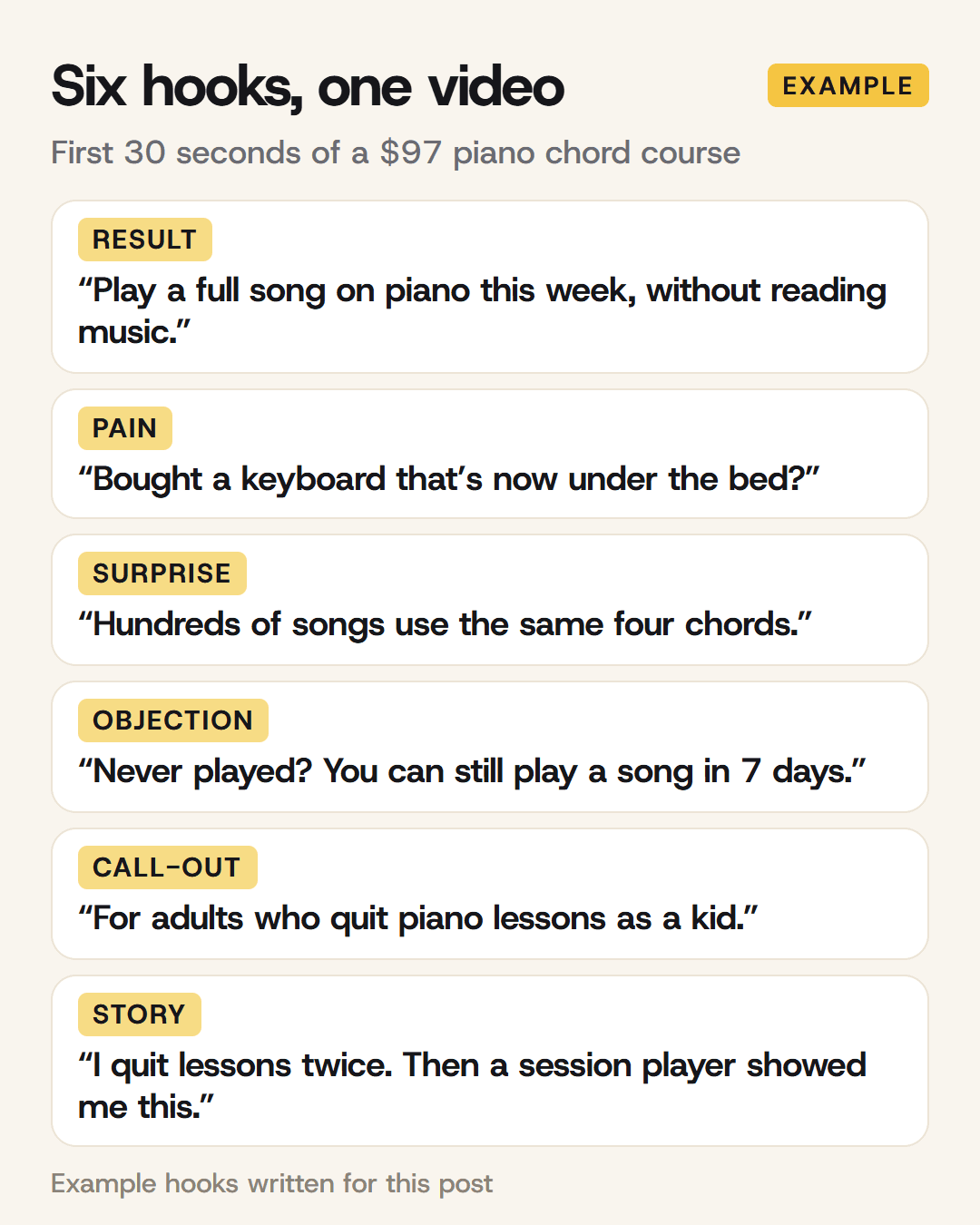
Why so many? Mike put it well on that call. He described the usual approach as guessing at the offer and running two or three split tests. Instead, he said, try “10 or 20” completely different ways of describing the offer and the angle, then take the time to optimize the one that lands closest. It’s cheap to do now that copy is fast to write. Two hooks only tell you which of two guesses was better.
He also pointed out that small changes need a lot of traffic to measure. In his words, if he changed one sentence in his VSL he might need “like 50,000 landers” to know if it made a difference, but if he changed the whole body or the close, he might need a couple of hundred. So test big, clearly different versions first.
How to Test and Scale Funnels (Book a Call, VSL, Low Ticket)
Step 2: Run the hooks with a multi-armed bandit split
Record the first 30 seconds of each hook and stitch each one onto the same body of the video. Then put each version on its own copy of the VSL page and split the traffic between them.
A multi-armed bandit split sends more visitors to the versions that are earning more and fewer to the weak ones while the test runs, so you don’t keep paying to show a losing hook. It’s a way of splitting traffic inside your A/B test, not a different kind of test.

How long to run it depends on traffic. With a lot of traffic, a week can be enough. Around two weeks is typical. With low traffic, plan on a month or more. Run full weeks either way, because weekend visitors often behave differently. I explain how the split works in how a multi-armed bandit works.
Step 3: Test the offer section
Once you have a winning hook, test the second biggest lever: the offer. Keep the first 10 minutes the same and change the stack, the price, the bonuses or the guarantee. For example:
$97 vs $67 with a payment plan. Why: the cheaper price may sell more copies but less money. Only revenue per visitor tells you.
Guarantee vs no guarantee. Why: as my $5 book test showed, it can lose.
Bonus A vs bonus B. Why: the right bonus answers the main objection. The wrong one is just more stuff.
Mike’s other point applies here too: change the open, the close and the order page together if you want a fast answer, then fine-tune the winner. I cover more ideas in how to increase VSL conversions.
Step 4: Judge on revenue per visitor
This is where most VSL tests go wrong. A hook that keeps more people watching isn’t always the one that sells more. A curiosity hook can pull in viewers who watch out of curiosity and never buy.
Here’s an example with made-up numbers to show the effect. A $97 course VSL, 1,000 visitors on each hook:
Hook A (result): “Play a full song this week, no sheet music.” 35% watch past five minutes. 22 sales, $2,134, or $2.13 per visitor.
Hook B (curiosity): “The piano secret teachers don’t tell you.” 46% watch past five minutes. 15 sales, $1,455, or $1.46 per visitor.

B wins on watch time. A makes more money. (These counts are far too small to call a real winner. They only show the direction.)
So pick the winner on revenue per visitor: total revenue from the version, including upsells, divided by the people who landed on it. For a book-a-call VSL, the money comes weeks later, so use calls booked per visitor until the sales close. Watch time and play rate are useful for finding where people drop off, but they don’t decide the test. My guide to revenue per visitor vs conversion rate goes deeper, and VSL conversion rates covers what numbers to expect.
To find where people leave the page, I use your video host’s drop-off graph plus Microsoft Clarity, which gives you free heatmaps and session recordings. If people scroll past the video to look for the price, that tells you something about the length.
Common VSL script mistakes
A slow open. “Hi, I’m Sarah, and today I want to talk about…” Why it hurts: the first seconds go to you, not to the viewer’s problem.
The price too late. Why: if the reveal comes at minute 35 of a 40-minute video, only a small group ever hears it. Check your drop-off graph and see how many people are still watching at the price.
Proof after the price. Why: the viewer hears the cost before they believe the result.
No call to action in the close. Why: the people who decide in the last minute need to be told again what to do.
A page that fights the video. Why: long text, menus and links give people a reason to leave. On a VSL page, the video and the button should be the page.
Also check the page around the video. I go through that in my landing page CRO checklist, and if you wonder whether a short page with a VSL beats a long one, see short vs long landing pages.
How Splitlab helps
Splitlab runs A/B, multivariate and multi-armed bandit tests on funnel pages, including VSL pages built in ClickFunnels and GoHighLevel. You can test up to 10 or 20 hook or offer versions at once and let the bandit move traffic to the ones earning more. Every order, upsell and booked call (Cal.com, Calendly) is credited to the version the visitor saw, so revenue per visitor or calls booked per visitor decides the winner. See the features or book a demo.
FAQ
How long should a VSL script be?
Long enough to cover all 10 parts for your price. For a $27 to $97 product, 5 to 15 minutes is a good starting point. Book-a-call and high-ticket VSLs often run longer. Test the length if you have the traffic, and judge on revenue per visitor, not watch time.
What is the most important part of a VSL script?
The hook. Every other part only gets watched by the people the first 30 seconds convinced to stay. That’s why I write 5 to 10 hooks and test them before I touch anything else.
Should a VSL show the price?
For low-ticket offers, yes: reveal it after the proof and the offer stack, then send people to the order page. For high-ticket book-a-call offers, usually not. The price comes on the call.
What should I test first in a VSL?
The hook, then the offer section (price, stack, bonuses, guarantee). Big, clearly different versions give you an answer with less traffic than small wording changes.
How do I know which VSL version won?
Revenue per visitor, including upsells. For a book-a-call VSL, calls booked per visitor until the sales come in. A version with more viewers or a higher play rate can still make less money.
My final thoughts
The format isn’t a secret, and it isn’t mine. It’s the same order good salespeople have used for decades: get attention, earn trust, name the problem, show the fix, prove it, make the offer, remove the risk, ask.
If you only do one thing after reading this, write ten hooks before you record anything. The hook decides who watches the rest, and it’s the easiest part to test.
Then let revenue per visitor pick the winner, not your favorite line. If you want to run your first hook test with every sale tracked to the version the buyer saw, book a demo and we’ll set it up with you.
Your best script is the one your buyers chose.
Built for revenue
Test for revenue, not just clicks.
Run A/B, multivariate, and multi-armed bandit experiments — with real revenue tied to every variation.
We’ll increase your conversion rate by 30% or you don’t pay. Terms apply.
✓
Revenue per variation
✓
A/B & MVT
✓
Multi-armed bandit
Test for revenue, not just clicks.
A/B, multivariate and multi-armed bandit experiments, with real revenue tied to every variation.